

RFID jewelry inventory: how stocktaking works without handling every piece
RFID jewelry inventory means reading a tag on each piece with a reader, instead of lifting and checking pieces one by one. The reader collects codes by radio and software compares them with your stock list. This guide covers tags for small and metal pieces, what to test first, and what public studies do and do not show.
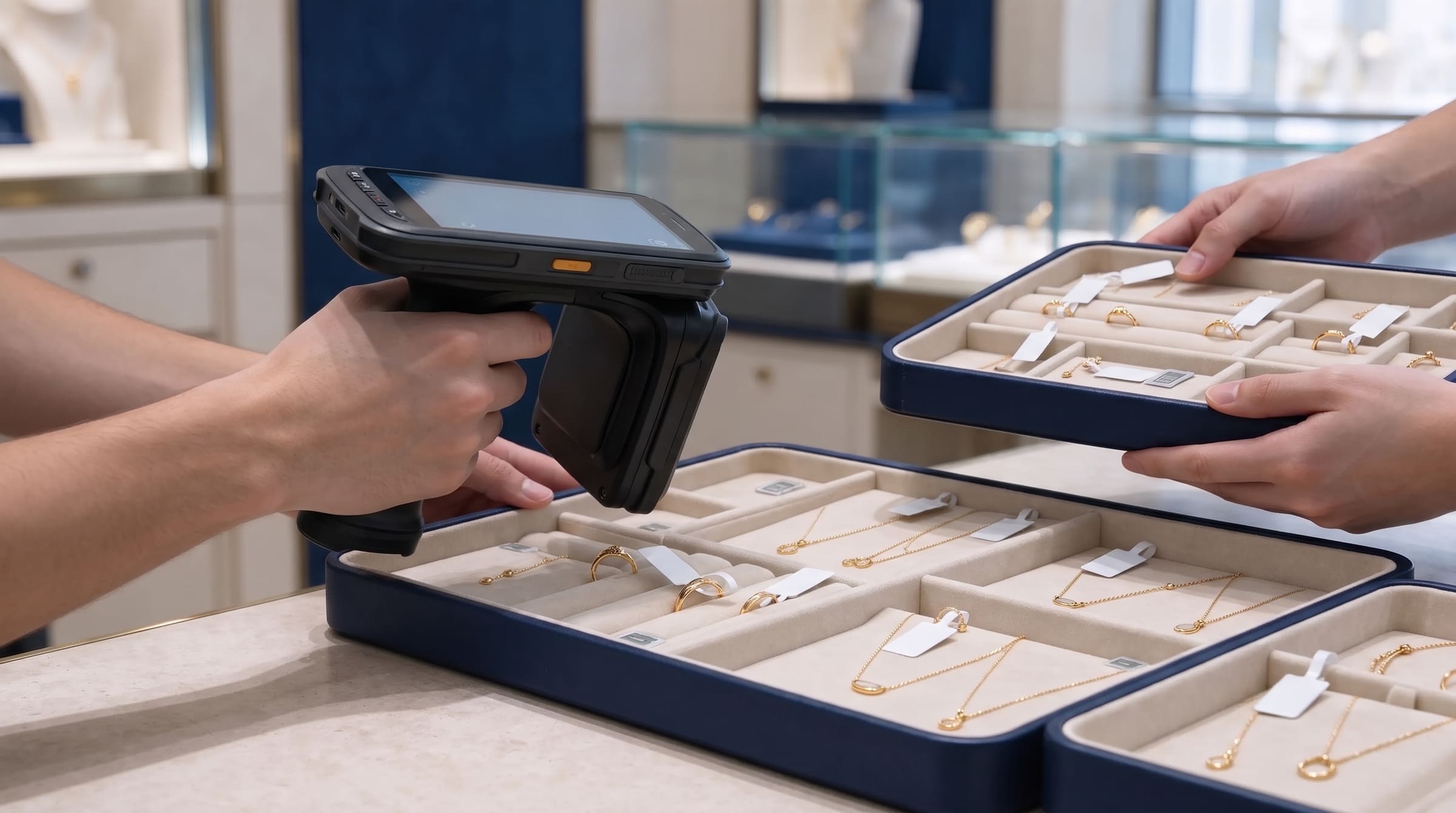
How does a jewelry stocktake work with RFID?
A manual jewelry stocktake means opening the showcase, lifting each piece and checking it against a list. An RFID stocktake changes how the pieces are identified. Each piece carries a tag that holds a unique code, a reader collects the codes by radio, and software compares them with your stock list. GS1 Australia explains that EPC-enabled RFID can allow a reader to scan multiple products without line of sight, and that in a single pass thousands of products can be identified simultaneously (GS1 Australia, EPC/RFID, 2026).
In most shops an RFID stocktake follows the same five steps:
- Tag. Each piece receives a tag with a unique code when it enters stock. The RAIN RFID Alliance advises that identifiers should be unique and that tags should be locked after encoding, so a code cannot be rewritten by accident (RAIN RFID Alliance, RAIN RFID: Lessons learned from the field, V.1.0, 2021).
- Read. A handheld or fixed reader collects the codes from a tray, a showcase or a drawer, without handling each piece.
- Compare. The software matches the codes it read with the stock list from your ERP or POS.
- Report. Pieces that are missing, misplaced or not on the list appear as differences.
- Update. After someone checks the differences, the stock records are corrected.
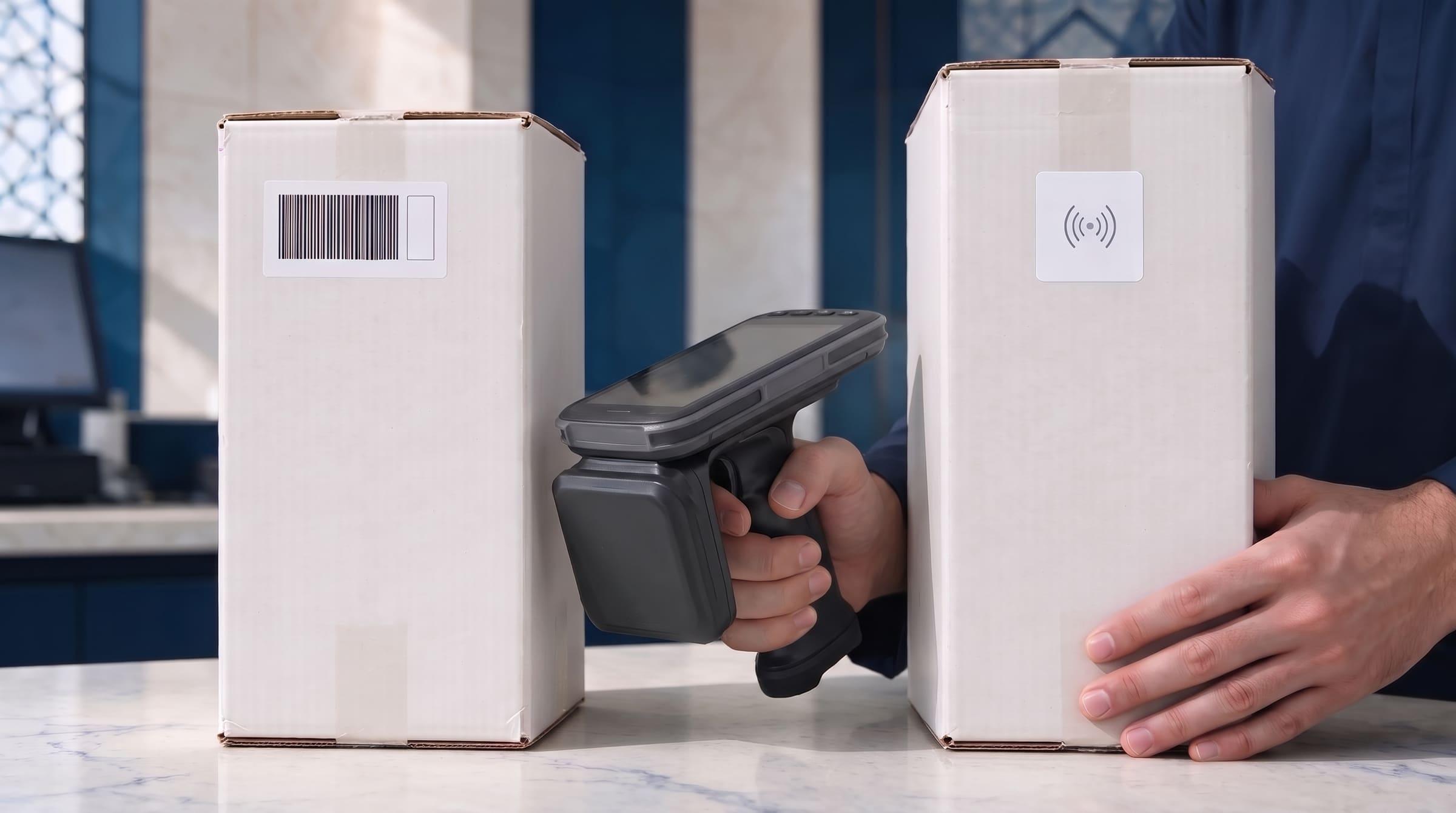
The barcode does not go away. GS1 Australia notes that a barcode still needs to be on the label (GS1 Australia, EPC/RFID, 2026), so the barcode on the label remains part of the process even where RFID is added.
One honest limit: this guide cites no jewelry-specific statistic, because we found no public figure for jewelry that we could verify. The studies in the last section come from general retail, and they are labelled that way.
What should you test before a full roll-out?
A lab or a sales demonstration shows the best case. The RAIN RFID Alliance advises treating lab results as best-case scenarios, not as predictions of field performance, and verifying performance on site in the real environment (RAIN RFID Alliance, RAIN RFID: Lessons learned from the field, V.1.0, 2021). For jewelry, that means testing with your own pieces in your own showcases before you commit. A useful pilot includes:
- Your smallest pieces and your largest, and the pieces with the most metal.
- Chains, bangles and pieces with stones, which sit differently in a tray.
- Trays that are stacked or packed closely, as they are at closing time.
- The real layout of your showcases, counters and safes, including glass, metal shelves and metal trays.
- Reader positions and the distance from reader to tags. The RAIN RFID Alliance advises designing the read zone for shorter read ranges, well within the limits of tag and reader, and using one reader per read zone (RAIN RFID Alliance, RAIN RFID: Lessons learned from the field, V.1.0, 2021).
- A manual count of the same area, done separately, so you can compare the two results.
Record what the test read, what it missed and what it read by mistake. The RAIN RFID Alliance also warns that tags from other applications can enter your read zone, so the setup should count only the tags you expect (RAIN RFID Alliance, RAIN RFID: Lessons learned from the field, V.1.0, 2021).
This is guidance for any buyer and any supplier. It is a checklist for judging a pilot, not an offer or a promise of results.
How does the count reach your POS and ERP?
A reader produces a list of codes. It does not produce a stock record. Software has to match each code to a piece, compare the result with the stock list and send the outcome to the systems that hold your inventory and sales, usually an ERP and a point-of-sale system.
Open standards exist for passing these read events around. GS1 describes the EPCIS standard as one that enables disparate applications to create and share visibility event data, both within and across enterprises (GS1 EPCIS Standard, Release 2.0, 2022). GS1 Australia also points to EPCIS and EDI as the electronic messaging that can be combined with barcodes and RFID to reach the greatest possible interoperability (GS1 Australia, EPC/RFID, 2026).
Whether your own ERP or POS accepts such events directly depends on the interfaces it offers, so ask early how counts will reach your stock records and who maintains that link. The Cyphra Tech ERP and POS integration page explains how RFID connects to those systems, and the gold and jewelry page covers stocktake for jewelry stores.
What does stock accuracy depend on?
Public studies on RFID and inventory accuracy exist, but none that we could verify is about jewelry. The two below are general retail evidence. They show a direction, and they are a reason to test on your own pieces, not a forecast for a jewelry store.
2 hours vs 53 hours
Counting 10,000 items took 2 hours with RFID scanning and 53 hours with a barcode reader in a 2009 retail study. The items were denim jeans in department stores, so this is general retail evidence, not jewelry evidence.
The University of Arkansas RFID Research Center ran the study for 13 weeks in two department stores and focused on two denim departments. Workers counted items with both RFID and barcode readers (University of Arkansas RFID Research Center, 2009).
55% to 65%
Auburn University RFID Lab reports that a typical value for Exact Match, the share of SKUs whose system count equals the physical count, is within 55% to 65%. This is general retail evidence, not jewelry evidence.
Source: Auburn University RFID Lab, Inventory Accuracy whitepaper, 2023
The same whitepaper explains that Exact Match is the most common way to calculate inventory accuracy, but that it does not show overall inventory health, because it does not account for the difference between a SKU that is nearly out of stock and a SKU that is missing one unit (Auburn University RFID Lab, Inventory Accuracy whitepaper, 2023).
For a jewelry store, accuracy will depend on the things this guide has covered: a tag that suits each piece, a sensible tag position, reader placement, a process that keeps every tag on its piece, and a clean link to your stock records. The RAIN RFID Alliance also notes that tags are not indestructible, because mechanical force or temperature extremes can crack the antenna or the chip connection (RAIN RFID Alliance, RAIN RFID: Lessons learned from the field, V.1.0, 2021).
Sources
Frequently asked questions about RFID jewelry inventory
Can RFID tags be read on metal jewelry?
It depends on the tag and the setup. The RAIN RFID Alliance says signals can be detuned by metallic objects and that on-metal tags are designed for metal surfaces (RAIN RFID Alliance, RAIN RFID: Lessons learned from the field, V.1.0, 2021). Test the tag type you are offered on your own pieces.
Is there a jewelry-specific RFID accuracy statistic?
We cite none, because we found no public jewelry figure that we could verify. The public results we could verify are general retail evidence, from University of Arkansas RFID Research Center, 2009 and Auburn University RFID Lab, Inventory Accuracy whitepaper, 2023.
Do jewelry labels still need a barcode with RFID?
GS1 Australia notes that a barcode still needs to be on the label, even where RFID is used (GS1 Australia, EPC/RFID, 2026).
Can a showcase be counted without opening it?
RFID does not need line of sight, according to GS1 Australia, EPC/RFID, 2026. Metal shelves and trays reflect signals, though, so reader placement for each showcase should be tested before you rely on it.
Where to go next
Talk to us about RFID for your business
Tell us your industry and the items you need to track. We reply with the tags and readers that fit.