

UHF vs HF and NFC: which RFID frequency do you need?
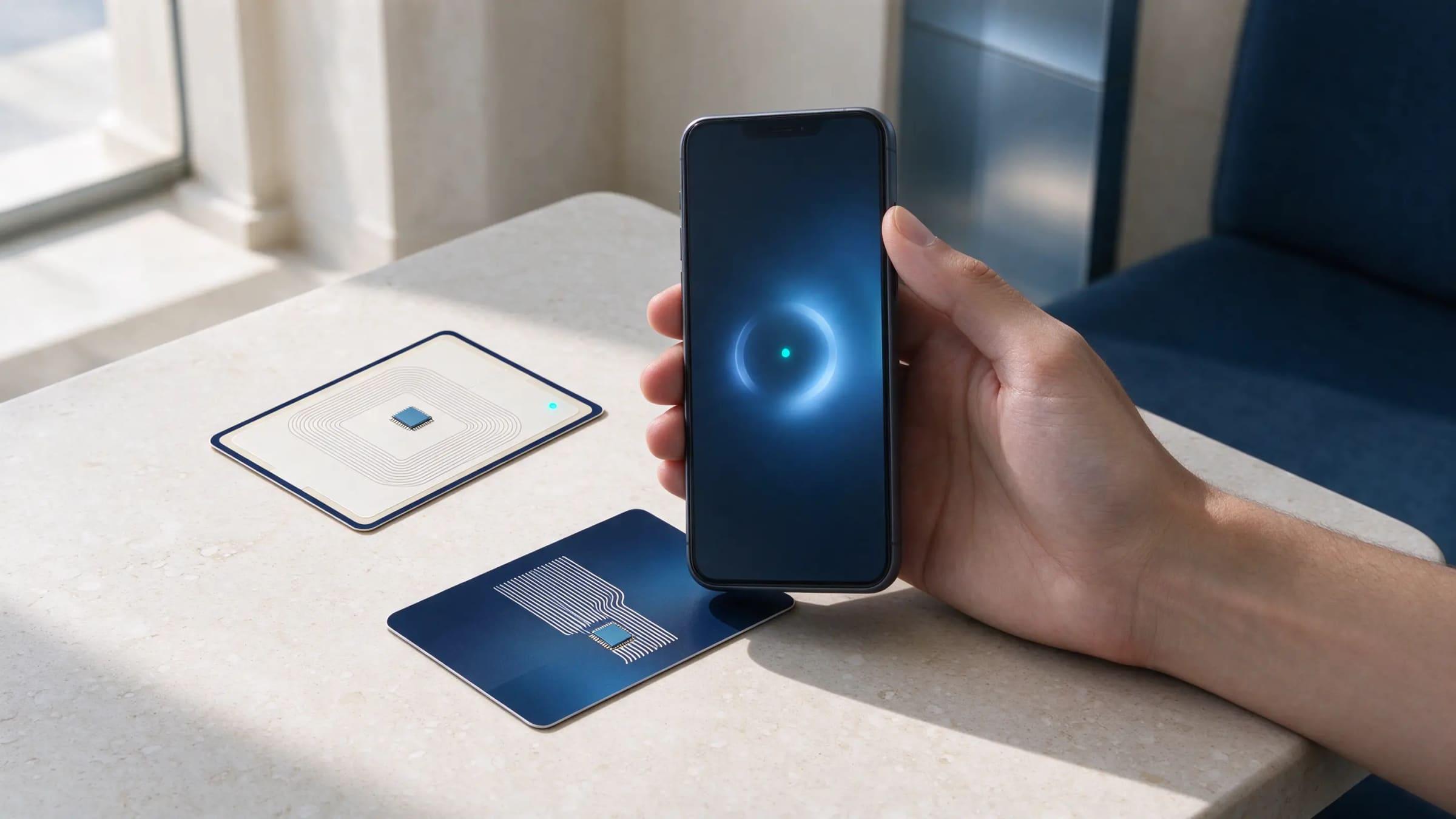
UHF, HF and NFC are three ways for a reader to talk to a tag or card by radio. UHF suits reading many items at a distance, such as stock counts, while NFC suits a deliberate tap, such as a phone, an access card or a payment. This guide compares them using public sources and explains how to choose.
What is the difference between UHF, HF and NFC?
UHF, HF and NFC are three ways for a reader to talk to a tag or card by radio. They differ in the frequency band they use, the standards behind them, how far apart the reader and the tag can be, and the jobs they usually do. GS1 Australia points out that not all RFID tags are the same: GS1 standards focus on UHF and HF passive tags, and the most broadly implemented tags in the industries it serves are UHF passive tags, also known as RAIN RFID tags (GS1 Australia, EPC/RFID, 2026).
A passive tag has no battery of its own. The GS1 EPC Gen2 UHF standard describes a passive-backscatter system in which the reader, which it calls an interrogator, talks first. It states that tags are passive, meaning that they receive all of their operating energy from the interrogator's radio signal, in the 860 MHz to 930 MHz frequency range (GS1 EPC Gen2 UHF RFID Standard, Release 3.0.1, 2026).
The NFC Forum describes near field communication as a contactless technology that works over radio on a base frequency of 13.56 MHz. NFC devices can communicate with ISO/IEC 14443 Type A and Type B readers and cards and with ISO/IEC 15693 cards (NFC Forum, NFC Technology: Technical Overview, 2026). HF and NFC are closely related, and this guide says so where a source speaks only about NFC.
The table sets out only what these sources state. It does not compare price, which depends on your items, your volumes and your supplier.
| Technology | Where it is used | Standard |
|---|---|---|
| UHF | Cases, pallets and logistic units in general distribution, and products for electronic article surveillance on the shop floor | EPC Gen2 UHF standard for passive tags in the 860 MHz to 930 MHz range; UHF passive tags are also known as RAIN RFID tags |
| HF | The same jobs as UHF, in distribution and for shop-floor article surveillance, as GS1 Australia describes UHF and HF together | HF passive tags are covered by GS1 standards, together with UHF |
| NFC | Mobiles, tablets, wearables, door locks, and tags in apparel and packaging; payment and public transport tickets through card emulation | NFC Forum specifications; base frequency 13.56 MHz; works with ISO/IEC 14443 Type A and B and ISO/IEC 15693 cards |
Source: GS1 EPC Gen2 UHF RFID Standard, Release 3.0.1, 2026; NFC Forum, NFC Technology: Technical Overview, 2026; GS1 Australia, EPC/RFID, 2026
How far can each one read?
Read range is the most visible difference, and the one most often misunderstood. The picture below shows relative reach only: UHF works in the far field and covers a wide zone, while HF and NFC work in the near field and cover a tight zone around the reader.
- One reader is the source of both zones.
- The wide UHF zone is the far field, where many tags can be heard in one pass.
- The tight HF and NFC zone is the near field, for one card or phone held close.
The sources give two figures. GS1 Australia says that RAIN RFID can capture identifiers at distances well in excess of 10 metres, without line-of-sight contact (GS1 Australia, EPC/RFID, 2026). The NFC Forum gives a typical range of up to 2 cm for NFC, and 5 mm as the range of certified compliant NFC Forum connections (NFC Forum, NFC Technology: Technical Overview, 2026).
Do not treat either figure as a promise for your site. The RAIN RFID Alliance advises regarding lab results as best-case scenarios, and notes that read range is only one of many parameters for tag performance (RAIN RFID Alliance, RAIN RFID: Lessons learned from the field, V.1.0, 2021). Metal, water, tag orientation and reader placement all change what you get in practice.
Which RFID frequency fits item-level retail stock?
For counting stock in a shop or a stockroom, the deciding feature is reading many items at once. GS1 Australia describes EPC-enabled RFID as able to let a reader scan multiple products without line of sight, and lists simultaneous counting of inventory among the benefits (GS1 Australia, EPC/RFID, 2026). Because UHF passive tags are the most broadly implemented in the industries it serves, UHF is usually the first frequency to evaluate for counting items.
NFC solves a different problem. A typical range of up to 2 cm suits a customer or an employee tapping a phone on one item, not a reader sweeping a shelf (NFC Forum, NFC Technology: Technical Overview, 2026). The NFC Forum lists battery-less tags in apparel, packaging and other consumer products as a use case, and says that NFC devices can read tags that hold web addresses and contact details.
A simple way to decide is to start from the job:
- You count many items at once on shelves, racks or pallets: evaluate UHF.
- You want customers or staff to tap a phone on one item: evaluate NFC.
- You need both jobs: plan for both, as two systems that share the same stock records.
The retail details are on the retail and apparel page and the warehouse and logistics page. The barcode also stays: GS1 Australia notes that a barcode still needs to be on the label (GS1 Australia, EPC/RFID, 2026), and the RFID vs barcode guide explains when a barcode alone is enough.
Which one fits access cards and payments?
Access cards and payments are tap jobs, and they are the home ground of NFC. The NFC Forum says that its most common operating mode today is Card Emulation, which lets a device such as a mobile phone or a wearable emulate a contactless card and connect into an existing framework like payment. It names the emulation of contactless banking cards for payment and of contactless tickets for public transport as typical use cases, and it lists door locks among the products that NFC connects (NFC Forum, NFC Technology: Technical Overview, 2026).
For a door, what matters is that one person holds one card to one reader. NFC devices can communicate with ISO/IEC 14443 Type A and Type B readers and cards and with ISO/IEC 15693 cards (NFC Forum, NFC Technology: Technical Overview, 2026), so an NFC phone can talk to readers and cards of those types.
UHF is built for a different job: reading many tags at a distance, which is the opposite of a deliberate tap. Where you need one card to open exactly one door, a wide read zone is a disadvantage, not a feature. For doors, assets and people, see RFID for assets and access.
Can one system use both?
Yes, because they do different jobs and do not replace each other. GS1 treats barcodes and RFID as data carriers that can be combined with electronic messaging such as EDI and EPCIS to reach the greatest possible interoperability (GS1 Australia, EPC/RFID, 2026). The same thinking applies to UHF and NFC: the tags can differ, as long as the software ends up with one set of records.
In practice, UHF counts the stock, NFC opens the doors or lets a customer tap an item, and both feed the systems that hold your stock and access records. GS1 describes EPCIS as a standard that enables disparate applications to create and share visibility event data (GS1 EPCIS Standard, Release 2.0, 2022), which is one open way to pass events between systems.
Before you commit, test your own items with the readers you are offered. The RAIN RFID Alliance advises verifying performance on site instead of relying on lab results (RAIN RFID Alliance, RAIN RFID: Lessons learned from the field, V.1.0, 2021). The ERP and POS integration page covers the step after the read, which is how counts reach your stock records.
Sources
Frequently asked questions about UHF vs HF and NFC
Can a phone read UHF tags?
The NFC Forum describes what NFC devices can talk to, including ISO/IEC 14443 and ISO/IEC 15693 readers and cards and NFC Forum tags (NFC Forum, NFC Technology: Technical Overview, 2026). UHF tags follow a different standard, EPC Gen2, so plan for a UHF reader if you need to read UHF tags.
Which reads farther, UHF or NFC?
UHF, by a wide margin in the published figures: GS1 Australia cites distances well in excess of 10 metres for RAIN RFID (GS1 Australia, EPC/RFID, 2026), against a typical range of up to 2 cm for NFC (NFC Forum, NFC Technology: Technical Overview, 2026). Real reach depends on the tag, the reader and the item.
Which RFID frequency is better for counting retail stock?
UHF is usually the first to evaluate, because GS1 Australia describes UHF passive tags as the most broadly implemented and RFID as able to scan multiple products without line of sight (GS1 Australia, EPC/RFID, 2026). Test it on your own items before you decide.
Can NFC be used for access cards and payments?
Yes. The NFC Forum names the emulation of contactless banking cards for payment as a typical use case and lists door locks among the products NFC connects (NFC Forum, NFC Technology: Technical Overview, 2026).
Where to go next
Talk to us about RFID for your business
Tell us your industry and the items you need to track. We reply with the tags and readers that fit.